Tanpa Ruang Kelas, Tanpa Batas: Kisah UICI dan Jutaan Orang yang Belum Sempat Kuliah
27 Mar 2026
22 Dec 2025

SEVIMA.COM – For many Indonesian lecturers and researchers, producing quality research is no longer the challenge; ensuring that it creates real impact is. Indonesia has been making strides in research, with publication counts on the rise and patent activity gaining traction. Yet, its Southeast Asian peers are already nearing the finish line in producing tangible innovation while Indonesia continues to lag behind.
A 2022 study by Dalibor Fiala, published in the Journal of Social Sciences and Humanities by Universitas Islam Indonesia, analyzed more than 330,000 journal articles indexed in the Web of Science between 2001 and 2020. The verdict revealed a sobering reality: Indonesia placed last in nearly all measures of research productivity, from publications and citations per capita to R&D spending. Malaysia set the pace, Thailand and Vietnam surged forward, and even the Philippines managed to produce highly cited work despite its limited resources.
There was, however, a silver lining. Indonesia ranked second in the region for citations per paper – proof that the seeds of quality are already there. But without robust systems in the form of funding, infrastructure, and systemic support, those seeds rarely grow into strong trees that bear fruit for society.
This paradox has forced the country to rethink its approach. In 2025, Indonesia is turning to research downstreaming as its new playbook through launching two flagship programs; the Riset Konsorsium Unggulan Berdampak and Hilirisasi Riset Prioritas SINERGI. These two programs ensure that ideas don’t just sit as blueprints on the shelf, but are built into tools that society can actually use. Lecturers and researchers are being called to take part in translating ideas from laboratories and journals into real-world solutions.
This article explores Indonesia’s downstreaming agenda, examining its rationale, and the 2025 flagship programs; and shows how your role as a lecturer or researcher is being repositioned as a tool for nation-building beyond traditional knowledge production.
Indonesia’s commitment to downstreaming is embedded in the government’s Asta Cita agenda, which sets out eight national development priorities. Within this framework, research is not meant to be a locked vault of knowledge, but rather the engine that keeps industry, society, and national resilience running smoothly.
Minister Brian Yuliarto stated that the Ministry has aligned key programs, including the Program for Enhancing Research Downstreaming and Collaboration (Program Peningkatan Hilirisasi Hasil Penelitian dan Kerja Sama), with the Asta Cita roadmap; highlighted within a media brief in late July. This positions downstreaming as a bridge between universities, industries, communities, and the government, ensuring that innovations flow outward and into the fields of society with new jobs, technologies, and opportunities.
The challenge is underutilization. Research so far is similar to blueprints stored away in drawers; never built, never applied. Minister Brian Yuliarto has mentioned the ministry’s mission to change this by pushing for research that produces real-world answers and market-ready products. This ambition reframes research as a practical cornerstone of national development.
The Indonesian government turned over a new leaf in 2025, shortly after President Prabowo Subianto was sworn into office in October 2024. Downstreaming is now placed at the heart of both industrial and academic policy, backed by new funding streams, sharper objectives, and stronger university-industry collaboration. Put simply; Indonesia is shifting from writing research to working research.
All this talk of research downstreaming begs the question on what research downstreaming truly is. The following section dives deeper into existing definitions on this concept.
By the Ministry’s definition, research downstreaming is the process of creating an integrated research and development ecosystem, moving from the laboratory bench to the marketplace shelf. Minister Brian Yuliarto has described it as a bridge that connects research outputs to societal and industrial needs. It requires a sturdy foundation of collaboration across disciplines as a prerequisite for the success of the program.
Globally, the same concept is recognized under different names; research commercialization, knowledge valorization, and technology transfer.
Despite the different labels, all share one mission; to ensure that knowledge does not remain a silent manuscript, but to become a working tool for solving problems, fueling industries, and improving everyday life.
Indonesia has begun to take this lesson to heart. Long before research downstreaming became a headline in the national agenda, the seeds of this approach were already being planted through earlier initiatives; programs that quietly tested how universities and industries could work hand in hand to turn research into real-world outcomes.
These early initiatives were Indonesia’s rehearsal stage for the larger performance now unfolding in 2025. From pilot programs to funding schemes, the government steadily built mechanisms to help universities move beyond publication counts and toward measurable societal contributions.
One such step was the Matching Fund Program (Program Dana Padanan) launched in 2024, designed to act as a matchmaking service between universities and industries. By providing co-funding arrangements, it encouraged companies to invest in academic innovation while giving universities the resources to scale their discoveries. Another initiative introduced in 2023, the Research and Community Service Program (Program Penelitian dan Pengabdian kepada Masyarakat), offered universities sustained grants for research and innovation, ensuring that good ideas were created and nurtured.
These initiatives delivered results. At Institut Pertanian Bogor (IPB) University, for example, the Ministry’s Kedaireka 2024 Matching Fund supported 20 research proposals with 12 billion rupiah, matched by partners to reach 24 billion rupiah. The program provided researchers the platform to take their innovations further, supporting the needs of industries.
Another striking example came from Universitas Syiah Kuala’s Atsiri Research Center (ARC), which, in collaboration with Focustindo Cemerlang Bogor, launched four new skincare products under the Kedaireka 2024 program. This was research literally bottled and brought to market, providing proof that when funding, collaboration, and innovation align, research can leap off the page and into people’s hands.
These stories potentially strengthened the government’s resolve to make research downstreaming a national centerpiece in 2025. The lesson was clear; when research is treated not as an academic ornament but as an economic engine, society reaps the benefits.
Building on these foundations, the government introduced two new flagship programs designed to scale up collaboration and impact.
The Riset Konsorsium Unggulan Berdampak, or High-Impact Flagship Research Consortium, is one of the Ministry’s newest platforms to accelerate research downstreaming. This program aims to build highways where multiple research teams travel toward real-world solutions.
According to the Ministry’s official guidelines, the program funds consortia or associations of research from different universities to pool expertise, share risks, and accelerate innovation. Each consortium is made up of two to five teams, with two to four members per team. This design ensures that breakthroughs are not confined to one discipline or one campus, but emerge from the synergy of many.
The rationale rests on two pillars. First, impactful research requires long-term investment, where knowledge is handed forward and improved at every stage. Second, the government has created the legal and financial lanes to make this possible, including grants managed through the Ministry’s Research and Community Service Information System (Basis Informasi Penelitian dan Pengabdian kepada Masyarakat, also known as BIMA).
The program’s objectives are ambitious but concrete:
Eligibility criteria are designed to reward inclusivity. Leaders must be active lecturers listed in PDDIKTI, with proposals that include complete product roadmaps outlining each team’s role. Bonus points are given to consortia involving doctoral students, universities from remote or underrepresented regions, or lower-cluster institutions – ensuring the program uplifts the often underrepresented in national research networks.
Though still in its infancy, the Ministry announced the first batch of grantees in September 2025. For lecturers and researchers, this program becomes a launchpad that sets their research in motion. Instead of watching their research fade into forgotten documents, they now have a runway to transform ideas into products, services, and solutions with lasting societal impact.
Lecturers or researchers interested in joining future rounds of the program can apply through the Ministry’s BIMA platform. All stages of the process, from program announcements and proposal submission to selection, funding, monitoring, and output validation, are managed through the BIMA system. Consortium leaders are responsible for submitting proposals, uploading required partner statements and documents, and completing budget inputs directly on the platform. Once submitted, each proposal must be checked and approved by the respective university’s research and community service (Lembaga Penelitian dan Pengabdian kepada Masyarakat) office.
The flow of announcements and information is visualized through the general timeline below:
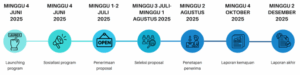
Credit: Buku Panduan 2025 Riset Konsorsium Unggulan Berdampak (RIKUB) by Kemendiktisaintek
In essence, the Riset Konsorsium Unggulan Berdampak is an invitation for lecturers and researchers: to trade isolation for collaboration, to replace static reports with working innovation, and to see research as the beginning of change.
Building on the momentum of this program, the Ministry introduced a second flagship program – Hilirisasi Riset Prioritas SINERGI – designed to take downstreaming one step further by tightly binding universities with industries and government through long-term, structured partnerships.
For the purpose of this article, the program translates to SINERGI Priority Research Downstreaming (2025 Integrated Technology Transfer-Based Research Downstreaming Scheme), and will be called SINERGI throughout.
According to the official guide, SINERGI is another flagship initiative of the Ministry’s Directorate General of Research and Development, designed to close the gap between academic research and societal impact by laying down highways connecting universities directly with industries and government. Its core mechanism is a matching fund scheme, in which the government matches financial and resource commitments made by external partners, ensuring that collaboration is a true and productive joint investment.
The program prioritizes universities with an existing record of cooperation with external stakeholders, reinforcing those partnerships to deliver solutions that address real-world challenges. In truth, SINERGI transforms collaboration from improvised projects into structured, long-term cooperation.
The objectives from this program include:
SINERGI requires research teams consisting of one leader and two to five members, complete with a set of requirements for all individuals involved. For example, the leader must be an active lecturer recognized in the Higher Education database (Pangkalan Data Pendidikan Tinggi, or PDDIKTI for short). Team members can come from the same or other universities, but at least one must be from the leader’s home institution.
Equally important is the role of the external partner, which is either a governmental institution or an industry. Government partners must be, at least, at the district or city agency level, while industrial partners must meet the minimum classification of a micro-enterprise (as regulated under Government Regulation No. 7/2021), proven with a valid Business Registration Number. Every consortium has a university, external partner, and government support; each leg essential for balance.
All proposal submissions and evaluations are carried out through the Hiliriset platform – the Ministry’s dedicated portal for this program. Like a centralized command center, Hiliriset manages everything from publishing program guidelines and funding announcements to proposal review, progress monitoring, and final output validation.
The stages of this program are visualized through the chart below.
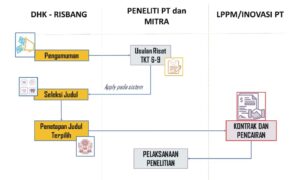
Credit: Panduan Program Hilirisasi Riset Prioritas SINERGI 2025
The stages generally follow a cycle of launching, socialization, proposal submission, selection, funding, monitoring, and final reporting; running between June and December each year. This timeline is visualized by the following infographic.
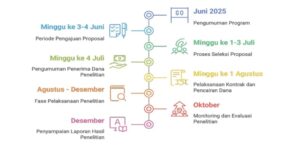
Credit: Panduan Program Hilirisasi Riset Prioritas SINERGI 2025
The benefits of SINERGI mirror those of the Riset Konsorsium Unggulan Berdampak, but with an added emphasis on partnership and scale. Research outputs supported through this scheme are intended to be products society can access, purchase, or adopt. For industries, the program opens the door to cutting-edge research that can refine processes, improve competitiveness, and spark new markets. For researchers, it provides a platform to move beyond theory and see their work come alive in ways that benefit multiple stakeholders. SINERGI represents the next gear in Indonesia’s downstreaming engine; creating research that is systemically woven into the country.
Baca juga: Mahasiswa dan Dosen Juga Bisa Berperan Aktif Sukseskan Hilirisasi, Ini 3 Tipsnya!
The following table illustrates the contrast between the two flagship programs.
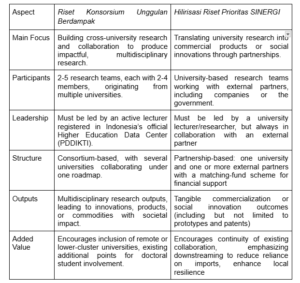
Taken together, the Riset Konsorsium Unggulan Berdampak and SINERGI programs illustrate two complementary approaches to downstreaming; one focuses on collaboration across campuses, the other on sustained partnerships with industries and government. The true measures of their success lies in what they mean for Indonesia’s higher education system – its opportunities, its hurdles, and its readiness to embrace a culture where research no longer stops at the journal, but continues into the marketplace.
Research downstreaming offers clear benefits for the economy, the workforce, and researchers themselves; yet, these come with challenges that require careful coordination and collaboration between the government, industry, and academia. Understanding both sides highlights why supporting downstreaming is crucial for turning research into real-world impact.
As noted by M. Nur Rianto Al-Arif in Detik News, downstreamed research holds transformative potential for economic growth. By converting knowledge and innovation into tangible, high-value products, Indonesia can diversify its economy and strengthen its export base. In practice, research-based products can serve as problem-solving tools that address real challenges while opening new sectors that reduce dependence on any single industry.
Downstreaming also creates new employment opportunities across the value chain, from product development and production to commercialization. Each stage requires skilled labor, strengthening workforce adaptability and productivity. The result includes a potential increase in jobs and better-prepared citizens equipped with the competencies to thrive in a knowledge-driven economy.
For researchers, downstreaming offers the chance to see their work move beyond academic journals into society. With government and industry support, ideas can materialize into products and services that directly benefit communities. This not only enhances visibility and recognition, but also expands professional networks – opening doors to investors, policymakers, and cross-sector collaborations. In short, downstreaming gives researchers a mirror to see the impact of their work, and an amplifier to escalate their role in shaping solutions.
The most immediate challenge is the need for sustained support from multiple stakeholders. As Dr. Mulyadi Sinung Harjono from The National Research and Innovation Agency of Indonesia emphasized; research cannot move to industry without strong policies, particularly those safeguarding intellectual property. Meanwhile, industries must often conduct multiple rounds of testing before new products reach the market – a process slowed by regulatory hurdles and consumer hesitation toward unfamiliar innovations. Products in sensitive sectors, such as automotive and pharmaceuticals, face even stricter approval requirements.
Another barrier is market readiness. Research outputs may be innovative, but without early adopters or sufficient demand, they struggle to gain traction. It is one thing to invent; it is another to convince society and industries that the invention solves their problems better than existing solutions. Here, researchers, industries, and government agencies must work hand-in-hand to align outputs with market realities, design protective regulations, and create pathways for new products to reach consumers.
This raises a critical question: are Indonesian universities ready for a research downstreaming-focused future? Signs of progress exist, where collaborative research teams have already leveraged government funding to produce tangible outputs. Yet, structural gaps remain.
Prof. Daniel Murdiyarso, Chairman of the Indonesian Academy of Sciences, highlights chronic underfunding as a root problem, leading to disparities in human resources, infrastructure, and research capacity. At the same time, as noted by Padjadjaran University lecturer Nandi Sukri, not all research naturally aligns with industry needs. Industries judge potential innovations by profit margins and scalability, while many campus projects overlook this commercial lens. The result is a persistent mismatch between academic outputs and industrial demand.
Overcoming these obstacles requires more than funding; it requires ecosystem-wide alignment. The government, industries, and universities must establish continuous dialogue, adjust research priorities to market realities, and co-develop strategies that make innovation both impactful and sustainable. Only through this cooperative approach can Indonesian higher education transition from being knowledge producers to becoming active architects of national resilience and growth.
Indonesia’s research downstreaming agenda marks a shift from knowledge for knowledge’s sake to knowledge in service of the nation. The 2025 flagship programs – Riset Konsorsium Unggulan Berdampak and SINERGI – offers complementary routes. One builds cross-campus consortia, while the other forges durable industry partnerships. If policy, funding, and market mechanisms align, Indonesia can move from isolated excellence to systemic impact.
Yet, vision alone is not enough; execution depends on how well universities manage the growing volume and complexity of research and community service programs. That is where tools like SEVIMA’s Litabmas Module become critical. By digitalizing proposal submission, funding allocation, monitoring, and reporting, the module helps universities ensure research is tracked, evaluated, and translated into real outcomes. In other words, it turns downstreaming from a national agenda into an operational reality on campus.
This need for strong campus-level execution is reinforced by Indonesia’s upcoming 2025 research roadmap, drafted at the Science, Technology, and Industry Convention, which identifies eight priority sectors; from energy to security and downstreaming. The roadmap underscores a clear message: research must serve as a strategic foundation for Indonesia’s future competitiveness.
For institutions ready to strengthen their research management and align with Indonesia’s downstreaming agenda, SEVIMA’s Litabmas Module provides a practical, integrated solution. We hope this article serves as a catalyst for researchers and lecturers to translate their ideas into real impact, supported by government programs and enabled by systems that make research management seamless.
Diposting Oleh:

Mayda
Tags:
SEVIMA merupakan perusahaan Edutech (education technology) yang telah berkomitmen sejak tahun 2004 dalam menyelesaikan kendala kerumitan administrasi akademik di pendidikan tinggi (Universitas, Sekolah Tinggi, Institut, Politeknik, Akademi, dll.) dengan 99% keberhasilan implementasi melalui SEVIMA Platform, segera jadwalkan konsultasi di: Kontak Kami